
Price Fiction: Why Automated Home Values Don't Belong in Divorce Cases

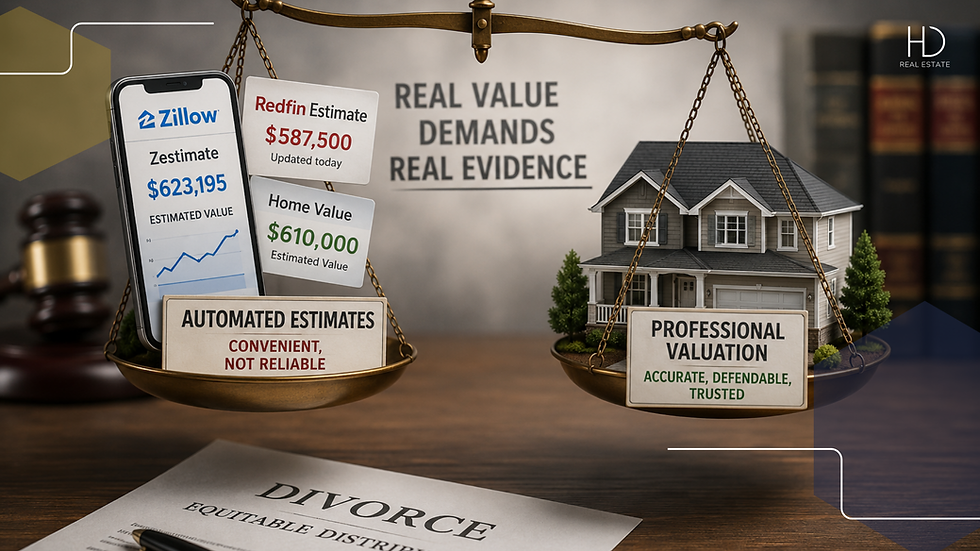
When real estate is part of a divorce, it's important that property valuations are accurate, well-supported, and able to withstand scrutiny. That's why I wanted to share a quick reminder about automated valuation models (AVMs), such as Zillow's Zestimate, Redfin Estimate, and similar online pricing tools.
Although these estimates are convenient, they are not designed for legal matters where a home's value can significantly impact the division of assets.
AVMs rely on algorithms that analyze public records and broad market data. What they cannot do is inspect the property itself. They don't evaluate the home's condition, recognize recent improvements or deferred maintenance, consider unique architectural features, or account for neighborhood nuances such as premium views, lot characteristics, or school district boundaries. They also struggle to reflect rapidly changing micro-market conditions. As a result, these automated estimates can differ substantially from actual market value—particularly for unique or distressed properties, which frequently arise in family law cases.
Even Zillow acknowledges that its Zestimate is intended only as a starting point and should not replace an appraisal or professional valuation.
Zillow also publishes statistics on the accuracy of its estimates through its "Zestimate Accuracy" page. If you review the data, you'll notice separate reporting for Active Inventory and Off-Market properties. The Active Inventory results are influenced by the fact that these homes have already been professionally priced before being listed.
The more meaningful data for divorce matters is found in the Off-Market section. There, users can review regional error rates that reflect homes not currently listed for sale.
The results are telling:
Fewer than half of off-market Zestimates fall within 5% of the eventual sale price.
For a $600,000 property, that means the estimate is within approximately $30,000 of market value less than 50% of the time.
Properties that are unique, have limited comparable sales, or lack sufficient market data can experience valuation errors exceeding 20%.
Even beyond those variances, Zillow reports an overall median error rate of roughly 7%.
These figures highlight why online estimates should not be relied upon when significant financial decisions are involved. Lenders, appraisers, and experienced real estate professionals do not use AVMs as the basis for financing, underwriting, or establishing market value in transactions. The potential margin of error is simply too great.
In the context of divorce, an unsupported online estimate can create unnecessary disputes, unrealistic expectations, and inaccurate settlement positions.
When a property's value matters, the most reliable approaches remain:
A licensed real estate appraisal; or
A Comparative Market Analysis (CMA) prepared by an experienced real estate professional who has personally evaluated the property and understands the local market.
If you or your clients need a credible, well-supported valuation for a divorce matter, I'm always happy to help.


Comments